

In comparing two typing methods, Rand’s coefficient and Wallace’s coefficient both describe how similarly the methods group the same isolates or samples, but they answer slightly different questions. Rand’s coefficient is an overall concordance measure: it looks at all pairs of samples and asks whether the two methods agree on which pairs are in the same group and which are in different groups. In this context, a value near 1 means the two methods classify pairs very similarly, while a value near 0 means little agreement beyond chance.
Wallace’s coefficient is directional, so it answers a different question: if two samples are the same type by method A, what is the probability they are also the same type by method B?. The reverse direction can give a different value, because one method may be more discriminatory than the other. So you usually see two Wallace values.
If Rand's coefficient is high, the two typing methods are broadly similar overall. If Wallace's coefficient is high in one direction but lower in the other, that usually means the more discriminatory method is subdividing clusters made by the less discriminatory method. In microbial typing, that directional information is often more informative than the single overall Rand's coefficient.
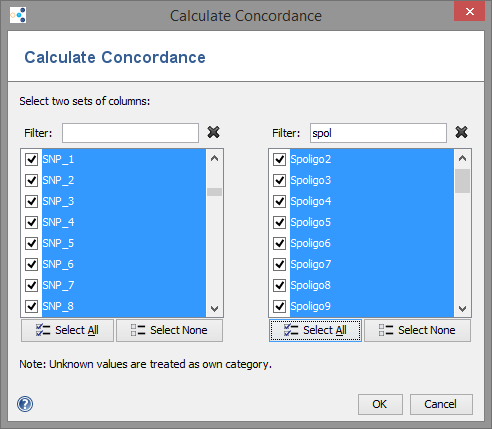
Calculate the concordance (Rand's and Wallace's Coefficients) between two sets of columns. This function can be used to compare the results of different typing systems.
For calculation, pairs of the results of 2 typing systems <math>(x,y): x,y \in {Samples}</math> of all Samples are created. All pairs are arranged in a 2x2 table, according to their type in both typing systems:
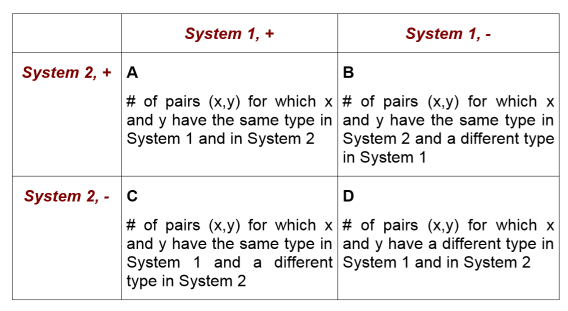
The ratio <math>\frac{(A+D)}{A+B+C+D}</math> is the frequently called in publications the typing system concordance. This value is also known as Rand's coefficient.
However, if comparing two random data sets, concordance calculation does not approach the value 0. Therefore, when calculating the Adjusted Rand coefficient, a correction factor is used to take into account the presence of chance agreement:
Adjusted Rand = <math>\frac {A+D-n_c}{A+B+C+D-n_c}</math> with
<math>n_c = \frac {n(n^2+1) - (n+1) \sum n_i^2-(n+1) \sum n_j^2+2 \sum \sum n_c = \frac {n_i^2 n_j^2}{n}}{2(n-1)}</math>
where <math>n</math> represents the total number of Samplesand <math>n_i, n_j</math> represent the numbers of Samples with values <math>i</math> and <math>j</math> for System 1 and System 2.
Wallace's coefficients are calculated by
<math>W_1 = \frac {A}{A+B}</math> and
<math>W_2 = \frac {A}{A+C}</math>
They represent the probability that a pair of Samples that have the same type in System 1 also have the same type in System 2 and vice versa.
Unknown values are treated as own category.
References
Carriço J.A., Silva-Costa C., Melo-Cristino J., Pinto F.R., de Lencastre H., Almeida J.S., Ramirez M. Illustration of a common framework for relating multiple typing methods by application to macrolide-resistant Streptococcus pyogenes. J. Clin. Microbiol. 2006, 44: 2524-32 [PubMed 16825375]
FOR RESEARCH USE ONLY. NOT FOR USE IN CLINICAL DIAGNOSTIC PROCEDURES.